
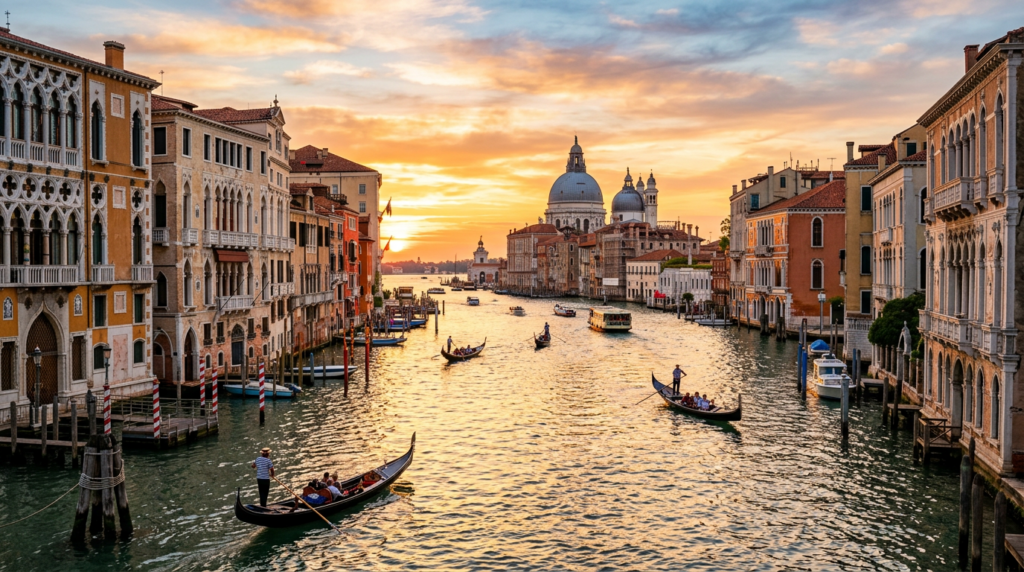
Italy's cultural golden triangle — Venice, Florence, and Milan — represents the pinnacle of European art, architecture, and style. From the floating palaces of Venice to Florence's Renaissance treasures to Milan's fashion-forward energy, these three cities offer entirely different yet equally mesmerising experiences.
Venice — The Floating City
There is nowhere else on Earth like Venice. Built on 118 small islands connected by 400 bridges, with canals instead of roads and gondolas instead of taxis — Venice is a masterpiece of human audacity and artistry.
St. Mark's Square & Basilica
Napoleon called Piazza San Marco "the drawing room of Europe." The square is dominated by St. Mark's Basilica — its golden mosaics gleaming above, its Byzantine domes a reminder that Venice was a bridge between East and West. The adjacent Doge's Palace (Palazzo Ducale) — with its pink-and-white marble Gothic facade — was the seat of Venetian power for 700 years.
Cross the famous Bridge of Sighs — named for the sighs of prisoners crossing from the courtroom to the cells, catching their last glimpse of freedom through the bridge's stone windows.
The Grand Canal
Venice's main "street" — a 3.8-kilometre S-shaped waterway lined with over 170 palaces spanning 500 years of architecture. Take a vaporetto (water bus) Line 1 from Piazzale Roma to San Marco for the most beautiful urban commute in the world. At sunset, the palaces glow gold and pink — it's impossibly romantic.
Getting Lost in Venice
The real magic of Venice lies in getting deliberately lost. Wander away from San Marco into the quiet residential sestieri: Cannaregio (the old Jewish Ghetto, Venice's most authentic neighbourhood), Dorsoduro (home to the Peggy Guggenheim Collection and Gallerie dell'Accademia), and Castello (where laundry hangs between windows and cats sleep on bridges).
Islands: Murano, Burano & Torcello
Murano — the glass-blowing island, where artisans have practised their craft since 1291. Watch a master glassblower create a horse or a vase in minutes from molten glass.
Burano — possibly the most photogenic island in the world, with houses painted in a riot of vivid colours (fishermen's wives painted them so their husbands could spot home through the fog). Famous for lace-making and excellent seafood.
Torcello — the oldest inhabited island in the lagoon, now nearly deserted, with a hauntingly beautiful 7th-century cathedral.
Florence — Cradle of the Renaissance
Florence is where the modern world was born. In the 15th and 16th centuries, this city produced Leonardo da Vinci, Michelangelo, Botticelli, Machiavelli, and Galileo. The concentration of artistic genius per capita has never been equalled.
The Duomo — Florence's Crown
Brunelleschi's dome — the Cathedral of Santa Maria del Fiore — is Florence's unmistakable landmark. When it was completed in 1436, it was the largest dome in the world, and it remains an engineering marvel. Climb the 463 steps for close-up views of the Vasari frescoes inside the dome and breathtaking panoramas of Florence and the Tuscan hills.
Beside it, Giotto's Campanile (bell tower) and the Baptistery with its golden "Gates of Paradise" doors complete one of the most spectacular piazzas in the world.
The Uffizi Gallery
One of the world's greatest art museums — home to Botticelli's Birth of Venus and Primavera, Leonardo's Annunciation, Michelangelo's Doni Tondo, and masterpieces by Raphael, Titian, and Caravaggio. The gallery itself, designed by Vasari in 1560, is a work of art.
Ponte Vecchio & the Oltrarno
The Ponte Vecchio — Florence's oldest bridge, lined with jewellers' shops since the 16th century — is one of Italy's most romantic landmarks. Cross it to the Oltrarno — Florence's artisan quarter, where craftsmen still work leather, wood, and silver using centuries-old techniques. The Palazzo Pitti and Boboli Gardens are here too.
Michelangelo's David & Piazzale Michelangelo
The Galleria dell'Accademia houses the original David — 5.17 metres of Carrara marble carved by a 26-year-old Michelangelo. It's the most famous sculpture in the world, and seeing it in person is genuinely moving.
For the best view of Florence, climb to Piazzale Michelangelo at sunset — the entire city, from the Duomo to the Arno, laid out in golden light. Pure magic.
Milan — Capital of Style & Innovation
Milan is Italy's most modern and forward-looking city — the fashion capital, the business hub, the city that never stops innovating. But beneath the contemporary surface lie extraordinary historical treasures.
The Duomo di Milano
Italy's largest church (and the world's third-largest) took nearly 600 years to build. Its forest of 135 marble spires, 3,400 statues, and the golden Madonnina on the highest spire make it one of the most extraordinary Gothic buildings ever created. Walk on the rooftop terraces among the spires for a surreal experience.
The Last Supper
Leonardo da Vinci's The Last Supper, painted on the wall of the refectory of Santa Maria delle Grazie, is one of the most famous images in human history. Viewing is limited to groups of 25, for just 15 minutes — book months in advance.
Galleria Vittorio Emanuele II
The world's oldest active shopping mall (opened 1877) — a stunning glass-and-iron arcade connecting the Duomo to La Scala opera house. With Prada, Gucci, and Louis Vuitton boutiques under painted ceilings and mosaic floors, it's been nicknamed "the living room of Milan."
Fashion & Design
The Quadrilatero della Moda (Fashion Quadrangle) — bounded by Via Montenapoleone, Via della Spiga, Via Manzoni, and Corso Venezia — is the world's most exclusive fashion district. Even if shopping isn't your thing, the window displays are art installations.
Milan's annual Salone del Mobile (Furniture Fair) and Fashion Weeks make it the global capital of design.
Plan Your Italian Art Cities Trip
Best route: Milan → Florence → Venice (or reverse). High-speed trains connect all three: Milan–Florence (1h45), Florence–Venice (2h15).
Best time to visit: April–June and September–October
Book ahead: Uffizi, Accademia (David), Last Supper, and Doge's Palace all require advance tickets
Must-try food: Risotto alla Milanese and cotoletta (Milan), bistecca alla fiorentina and ribollita (Florence), sarde in saor and cicchetti (Venice)
Venice tip: Visit in November–February for the atmospheric acqua alta (high water) season and the legendary Carnival in February
Bring Italy's Art Cities Home
Venice, Florence, and Milan are cities that change you. Our growing Italy collection captures the magic of these extraordinary destinations.
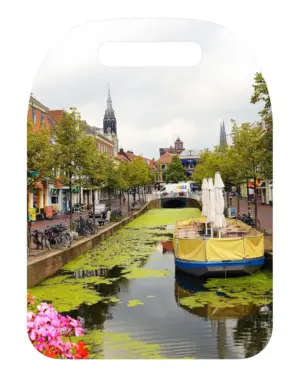
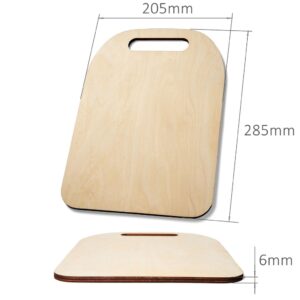
Browse all Italy souvenir boards →
Venice, Florence, Milan, and Rome designs are being added to our collection — subscribe to our newsletter for updates!