
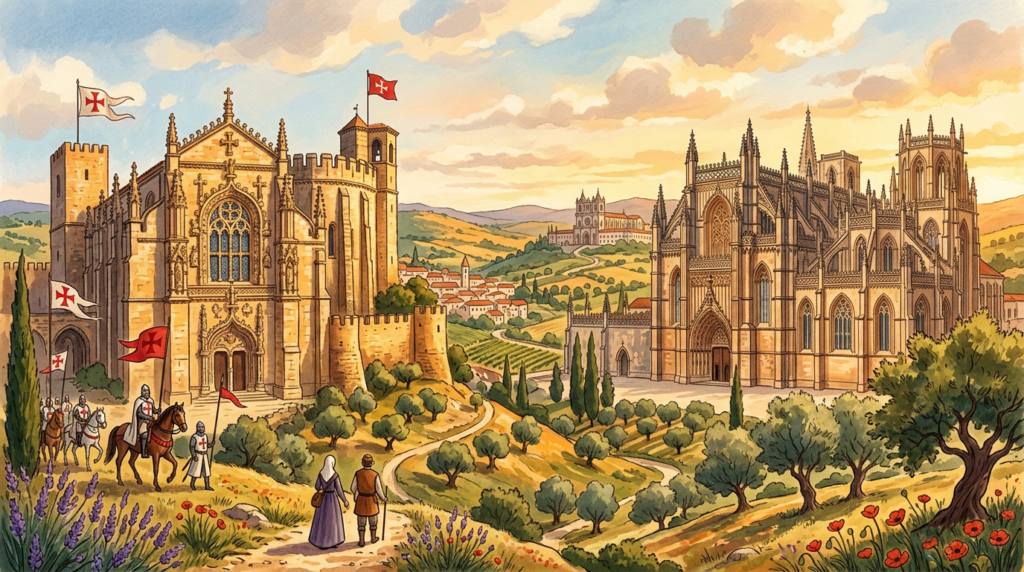
In central Portugal, three extraordinary monasteries tell the story of medieval faith, military orders, and architectural genius. The Convent of Christ in Tomar (Knights Templar headquarters), the Monastery of Batalha (celebrating Portugal's independence), and the Monastery of Alcobaça (Cistercian masterpiece) — all UNESCO World Heritage Sites — form a "triangle" that can be visited in a single spectacular day trip from Lisbon.
Getting There
From Lisbon: Each monastery is 1-1.5 hours from Lisbon by car. A circular route (Lisbon → Tomar → Batalha → Alcobaça → Lisbon) covers all three in a day (total driving: 3.5 hours). Alternatively, buses run from Lisbon's Sete Rios station to all three towns.
Tomar — The Templar Fortress
The Convento de Cristo in Tomar is one of Portugal's most important monuments — the former headquarters of the Knights Templar (later the Order of Christ). Built in the 12th century on a hilltop above the town, this fortress-monastery complex spans seven cloisters and 500 years of architectural evolution from Romanesque to Renaissance.
The star is the extraordinary Manueline Window (Janela do Capítulo) — arguably the most ornate stone carving in the world, featuring maritime ropes, seaweed, coral, chains, and an armillary sphere, celebrating Portugal's Age of Discovery. Inside, the circular Charola (Templar rotunda) was designed so knights could attend mass on horseback.



Batalha — Victory in Stone
The Mosteiro da Batalha (Monastery of the Battle) was built to celebrate Portugal's victory over Castile at the Battle of Aljubarrota (1385), which secured national independence. The ornate Gothic-Manueline facade is a masterpiece of stone tracery, with flying buttresses and pinnacles reaching for the sky.
The Capelas Imperfeitas (Unfinished Chapels) are perhaps the most hauntingly beautiful monument in Portugal — soaring Manueline arches open to the sky, their roof never completed, leaving carved stone columns framing nothing but blue sky and clouds. The massive octagonal portal by Mateus Fernandes is covered in extraordinary botanical and maritime carvings.
Alcobaça — Cistercian Purity
The Mosteiro de Alcobaça is the largest church in Portugal and a supreme example of early Gothic Cistercian architecture — soaring white stone vaults, clean lines, and an atmosphere of serene contemplation. The monastery was founded in 1153 by Portugal's first king, Afonso Henriques.
The most romantic feature is the twin tombs of Pedro and Inês de Castro — Portugal's greatest love story. Pedro, a prince, secretly married Inês, a lady-in-waiting. When his father had her murdered, Pedro became king and allegedly had her corpse crowned queen. Their tombs are placed foot-to-foot so they will see each other first when they rise on Judgment Day.
Practical Tips
- Route: Start with Tomar (most complex, needs 2+ hours), then Batalha (1.5 hours), then Alcobaça (1 hour)
- Lunch: Eat in Batalha between visits — good restaurants on the main square facing the monastery
- Opening hours: All monasteries open 9 AM-6 PM (October-March) or 9 AM-6:30 PM (April-September)
- Combine with: Fátima is just 20 minutes from Batalha — easy to add as a fourth stop
Bring Medieval Portugal Home
The Templar fortress, the unfinished chapels open to the sky, the tragic love story in stone — these monasteries represent the pinnacle of Portuguese medieval art. Our MemBoards souvenir cutting boards capture their grandeur in beautiful detail.