
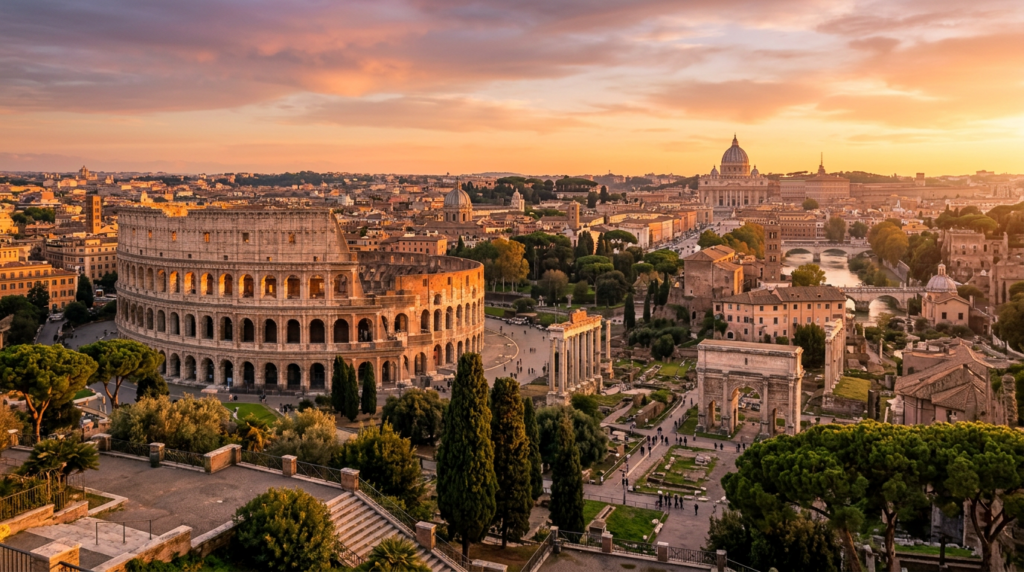
Rome is not just a city — it's a living museum spanning three millennia. From the Colosseum's ancient grandeur to the Vatican's spiritual majesty, from Trastevere's winding cobblestone lanes to the Trevi Fountain's baroque splendour — the Eternal City offers more history, art, and passion per square metre than anywhere else on the planet.
Ancient Rome
The Colosseum — Where Gladiators Made History
No image captures Rome more powerfully than the Colosseum. Built in 72 AD, this colossal amphitheatre held up to 80,000 spectators who watched gladiatorial combat, animal hunts, and even mock naval battles (the arena could be flooded). Nearly 2,000 years later, it remains the world's largest standing amphitheatre — and a monument to Roman engineering genius.
Stand in the arena where gladiators once fought, walk through the underground hypogeum (the backstage area with trap doors and animal cages), and look up through the missing roof at the Roman sky. It's spine-tingling.
Tip: Book a "Colosseum Underground" tour for access to areas normally closed to the public, including the gladiators' entrance tunnel.
The Roman Forum & Palatine Hill
Right next to the Colosseum, the Roman Forum was the political, religious, and commercial heart of ancient Rome. Walk the Sacred Way (Via Sacra) where Roman generals celebrated their triumphs, see the Temple of Saturn (the ancient treasury), and climb Palatine Hill for breathtaking views over the entire Forum.
One ticket covers all three sites — Colosseum, Forum, and Palatine — valid for two days.
The Vatican — Spiritual Heart of the Catholic World
Whether you're religious or not, the Vatican is an overwhelming experience. St. Peter's Basilica is the world's largest church — its dome designed by Michelangelo, its interior filled with masterpieces including the Pietà. Climb the 551 steps to the top of the dome for a panorama that stretches across all of Rome.
The Vatican Museums house one of the world's greatest art collections: the Raphael Rooms, the Gallery of Maps, and of course, the Sistine Chapel. Michelangelo spent four years painting the ceiling between 1508 and 1512 — lying on his back on scaffolding. The result is arguably the greatest artistic achievement in human history.
Tip: Book a "first entry" tour at 7:30 AM to experience the Sistine Chapel with a fraction of the usual crowds.
Baroque & Renaissance Treasures
The Trevi Fountain — Baroque at Its Best
The largest baroque fountain in Rome (and possibly the world), the Trevi Fountain is a theatrical masterpiece of marble, water, and light. Tradition says that throwing a coin over your left shoulder with your right hand guarantees you'll return to Rome. About €3,000 is thrown in daily — the money is collected and donated to charity.
Visit after 11 PM when the crowds thin and the fountain is illuminated — it's magical.
The Pantheon — 2,000 Years of Perfection
The best-preserved ancient Roman building, the Pantheon has been in continuous use for nearly 2,000 years. Its unreinforced concrete dome — with the famous oculus (9-metre hole) open to the sky — remains the world's largest of its kind. When it rains, water falls straight through and drains through 22 almost-invisible holes in the marble floor.
Inside, Raphael and two Italian kings are buried. Entry is free (reservation required).
Living Rome: Trastevere
Cross the Tiber to Trastevere, Rome's most characterful neighbourhood. Cobblestone streets, ivy-covered facades, laundry strung between buildings, and the sound of Vespas and laughter. This is where Romans come to eat — and the trattorias here serve some of the city's best cacio e pepe, carbonara, and supplì (fried rice balls).
The evening passeggiata (evening stroll) through Trastevere's piazzas, with buskers and fairy lights, is peak Rome.
The Spanish Steps & Piazza Navona
Rome's monumental squares are attractions in themselves. The Spanish Steps (135 steps connecting Piazza di Spagna to Trinità dei Monti church) are one of the city's most famous meeting points. Piazza Navona, built on the site of a 1st-century stadium, features Bernini's spectacular Fountain of the Four Rivers and buzzes with artists and cafés.
Day Trips: Pompeii & the Amalfi Coast
Rome makes an excellent base for exploring further south. Pompeii — the ancient city frozen in time by Vesuvius in 79 AD — is a haunting, unforgettable experience just 2.5 hours by train. The Amalfi Coast (Positano, Amalfi, Ravello) is one of the most beautiful stretches of coastline in the world.
Plan Your Rome Trip
Best time to visit: April–May and September–October (comfortable temperatures, manageable crowds)
Getting there: Rome Fiumicino Airport (FCO) is connected to the centre by the Leonardo Express train (32 minutes to Termini station).
Getting around: Rome is best explored on foot — most major sights are within walking distance. The metro (2 lines) is useful for longer distances.
Must-try food: Cacio e pepe, carbonara (the real one — no cream!), supplì, pizza al taglio, and gelato from an artisan gelateria.
Roman rules: No sitting on the Spanish Steps (€250 fine). No dipping feet in fountains. Cover shoulders and knees for churches.
Bring Rome Home
The Eternal City leaves a mark on everyone who visits. Our Italy souvenir collection captures the magic of Rome, Venice, and beyond — each board a daily reminder of la dolce vita.

Browse all Italy souvenir boards →
More Italian cities coming soon — sign up for our newsletter to be first to know!